 Hospital Administration Software
Healthcare organizations are being asked to do more with less: deliver better patient outcomes while managing rising administrative complexity. Manual workflows, siloed departments, delayed billing, and paper records don't just slow things down — they create real risk for patients and real cost for hospitals.
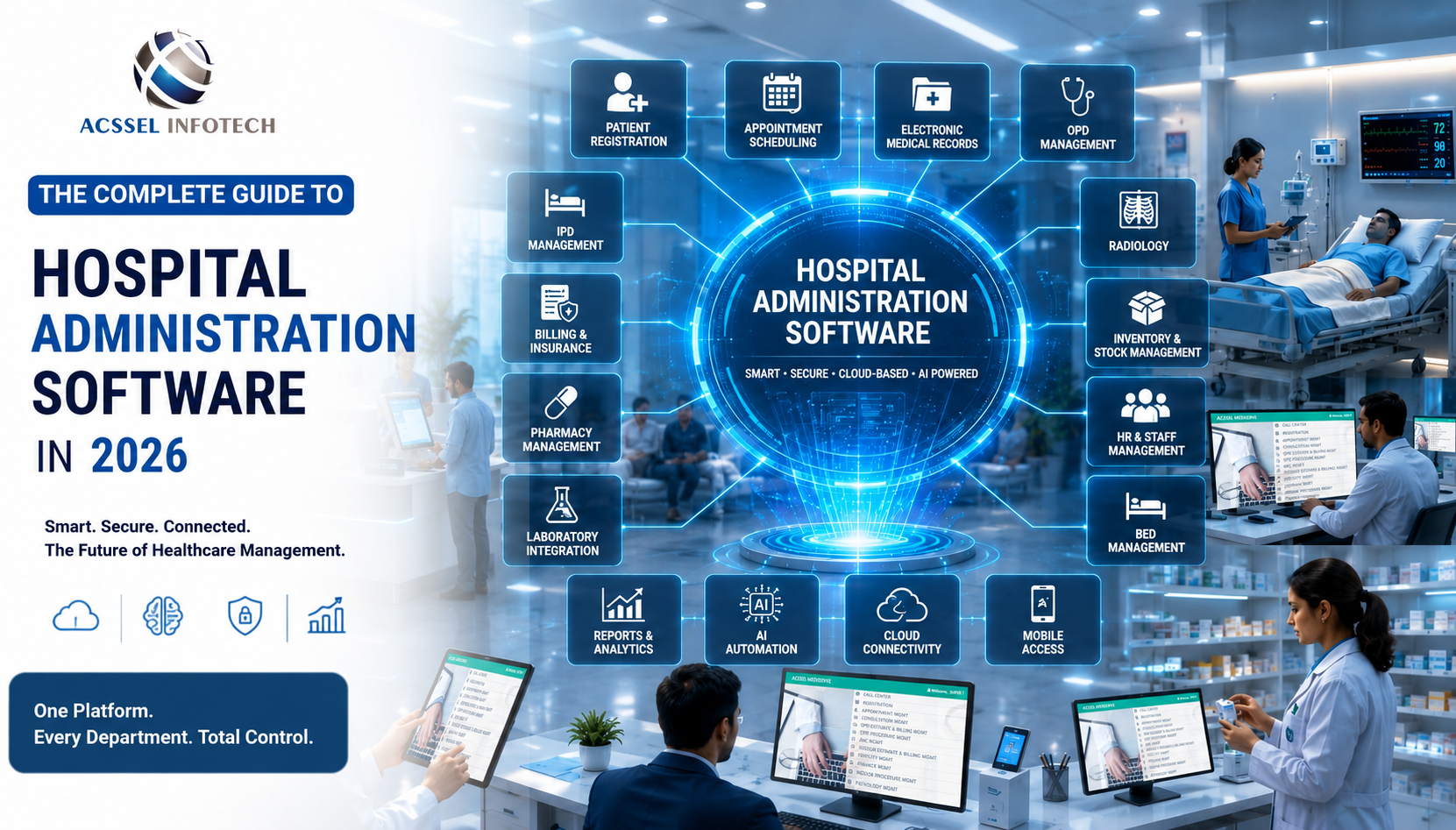
Hospital administration software addresses this by bringing registration, scheduling, billing, pharmacy, laboratory, and medical records into one connected platform.
At Acssel Infotech Healthcare Technology, we've spent over 20 years building software for hospitals, clinics, IVF centers, and nursing homes. The pattern we see consistently: the hospitals that get the most value aren't just buying software, they're rethinking how departments hand off work to each other. This guide walks through why that matters, what to look for, and how to choose well.
A mid-sized hospital generates thousands of patient records, appointments, prescriptions, lab reports, and billing transactions every month. Tracking that manually multiplies the chance of error at every handoff — a misfiled chart, a delayed claim, a double-booked slot.
Hospital administration software is a digital system that automates core hospital operations — patient registration, appointments, billing, pharmacy, laboratory workflows, inventory, and medical records — so staff spend less time on paperwork and more time on care.
The World Health Organization has pointed to digital health infrastructure as a key lever for improving both care delivery and patient safety when it's implemented with attention to local workflows, not just installed as an off-the-shelf system.
Core components:
Hospitals run on handoffs — between doctors, nurses, labs, pharmacy, and front-desk staff. Every handoff is a place where information can get lost or duplicated.
Workflow automation closes those gaps by routing information and tasks between departments automatically, instead of relying on phone calls, printed charts, or someone remembering to follow up.
What changes in practice:
Not all platforms are built the same, and the right feature set depends heavily on your facility's size and specialty mix. A few things are close to non-negotiable:
| Feature | Why it matters |
|---|---|
| Patient management | Covers the full patient lifecycle, not just intake. |
| Billing & insurance automation | Reduces claim denials and payment delays. |
| Inventory management | Tracks medicine and supplies to prevent shortages or waste. |
| ERP integration | Connects finance, HR, and procurement to clinical operations. |
| Analytics dashboard | Gives administrators real visibility into bottlenecks. |
Interoperability matters more than any single feature on this list. A system that can't talk to your existing lab equipment, PACS, or insurance clearinghouses will create new silos instead of removing old ones.
It's easy to frame this software as purely operational, but the patient-facing effects are often bigger. When staff spend less time on paperwork, they have more time for actual care. Digital appointment booking, automated reminders, and online access to reports also cut down the friction patients feel before they ever see a clinician.
Peer-reviewed research on health IT adoption has generally found that reducing clinical documentation burden correlates with more direct time with patients — though the size of that effect varies a lot by specialty and by how well the system fits existing workflows.
A representative pattern we've seen: hospitals that replace manual registration with digital intake typically report meaningfully shorter wait times and fewer billing corrections within the first few months — the exact magnitude depends on prior process maturity, so treat any single number you see quoted (including ones on vendor sites) as illustrative rather than a guarantee.
Every hospital's operational reality is different, so the "best" software is the one that fits your specialty mix, patient volume, and compliance requirements — and can scale as you grow.
Evaluation checklist:
Industry analysts consistently flag interoperability and long-term vendor support as the factors that separate successful rollouts from expensive ones that get abandoned within a few years.
"Technology should simplify healthcare, not complicate it. The best hospital administration software empowers caregivers by reducing administrative burden and improving outcomes." — Acssel Infotech Technology
What 20 years of implementations has taught us: the technology is rarely the limiting factor. Success depends just as much on staff training and on choosing software that matches how your teams actually work, rather than making them re-learn their jobs around a rigid system.
Hospital administration software has moved from "nice to have" to foundational infrastructure. Done well, it reduces administrative drag, tightens financial performance, and—most importantly—gives clinical staff back the time they need for patients.
Whether you run a multi-specialty hospital, a nursing home, an IVF center, or a diagnostic lab, the right platform is less about features on a spec sheet and more about a partner who understands how your organization operates.
Ready to see it in practice? Book a personalized demo with Acssel Infotech Healthcare Technology and see how our Hospital Administration Software fits your operations.
Acssel Infotech Healthcare Technology has over 20 years of experience building healthcare software for hospitals, clinics, IVF centers, and diagnostic centers, helping providers automate operations, reduce administrative workload, and improve patient care.
Q1. What is hospital administration software?
A digital system that automates patient registration, billing, appointments, pharmacy, laboratory, inventory, and other hospital operations.
Q2. Who should use it?
Hospitals, clinics, nursing homes, IVF centers, diagnostic laboratories, and other healthcare organizations managing multi-department operations.
Q3. How does it improve efficiency?
By automating repetitive administrative tasks, connecting departments in real time, reducing duplicate data entry, and giving administrators visibility into operational bottlenecks.
Q4. What features matter most?
EMR, patient management, billing automation, pharmacy and lab integration, inventory management, analytics, and strong interoperability with existing systems.
Q5. Why choose Acssel Infotech Healthcare Technology?
Over 20 years of experience implementing healthcare software that's been shaped by real hospital workflows, not just feature checklists.