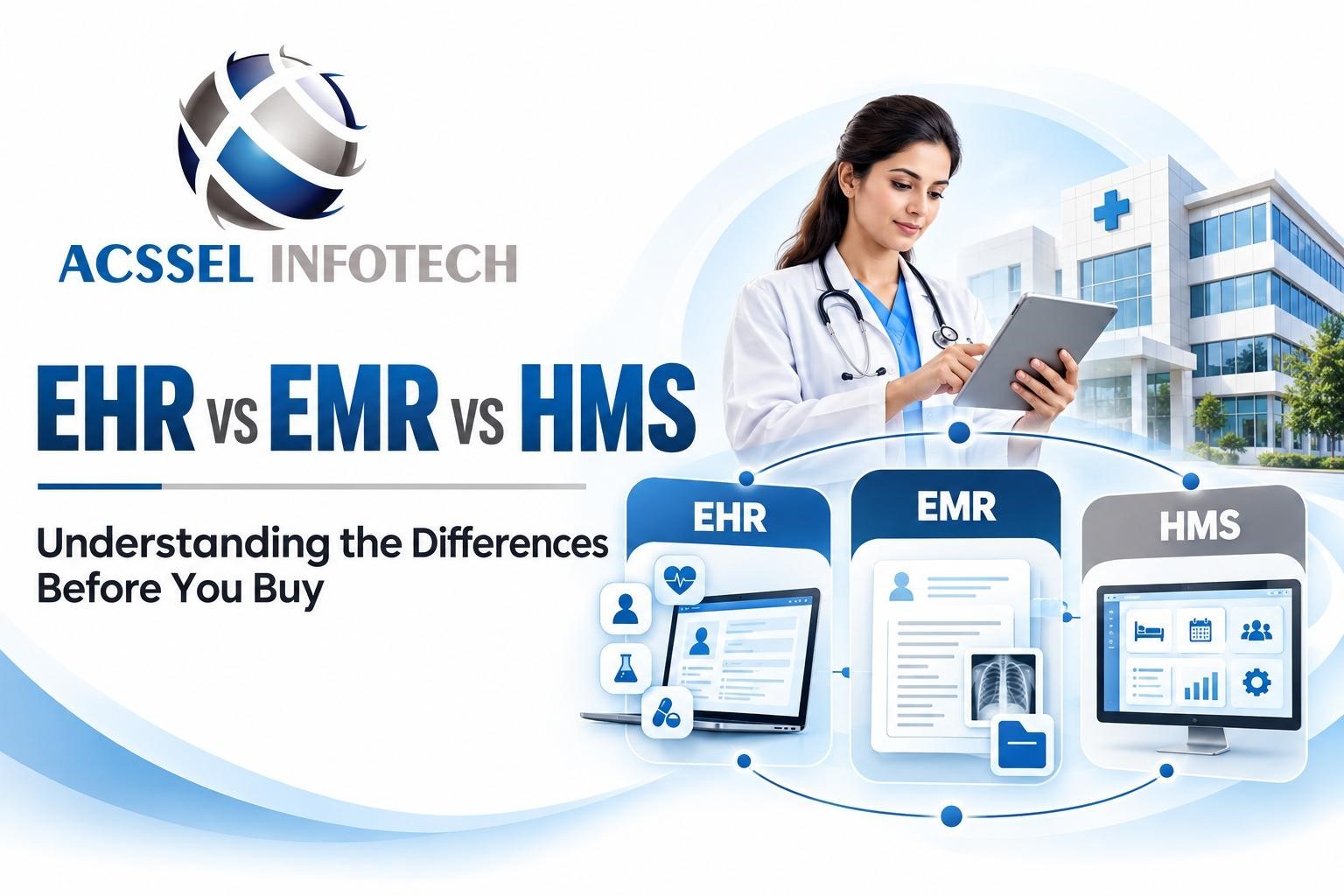
 EHR vs EMR vs HMS
An EMR does not easily travel outside the clinic walls. If a patient visits an external hospital or specialist, the EMR data remains locked within the original clinic unless printed or manually transferred. For practices modernizing individual clinics, implementing reliable Electronic Medical Records is the standard entry point.
An EHR goes far beyond the boundary of a single practice. It is designed to share clinical records across multiple healthcare organizations, including labs, pharmacies, imaging centers, emergency departments, and external specialists.
EHRs empower true continuum of care. When a patient arrives at an unfamiliar facility, doctors can access vital allergy data, past surgical records, and active medication regimens instantly. Adopting scalable EHR solutions ensures that your clinical staff participates in interconnected healthcare networks without communication silos.
While EMR and EHR focus primarily on clinical data, a Hospital Management System (HMS)—often called a Hospital Information System (HIS)—manages the entire operational, financial, and administrative machinery of a hospital.
An HMS acts as the central nervous system of a hospital. Clinicians document in the clinical module, pharmacy automatically dispenses medication, the billing counter receives the charges in real-time, and ward nurses receive automated bed allocation notices. Facilities seeking total operational control rely on a comprehensive Hospital Management System.
| Feature / Dimension | EMR | EHR | HMS |
|---|---|---|---|
| Primary Focus | In-clinic clinical charting | Cross-organization longitudinal health record | Total hospital operations, administration, and enterprise finance |
| Target Users | Solo practitioners, single-specialty outpatient clinics | Multi-specialty clinics, regional healthcare networks | Medium to large hospitals, multi-facility enterprises |
| Interoperability | Low (internal to single clinic) | High (standardized exchange across providers via FHIR/HL7) | Moderate to High (integrates internally across all departments) |
| Administrative Scope | Basic appointment scheduling | Scheduling and patient engagement portals | Comprehensive (IPD/OPD, HR, OT, Bed & Ward allocation) |
| Financial & Billing | Simple billing and invoicing | Medical billing and insurance claims | Full revenue cycle, supply chain, and asset tracking |
| Patient Access | Limited / Offline | Interactive patient web & mobile portal | Multi-department portal (appointments, bills, reports, discharge) |
Before evaluating vendors or signing software agreements, evaluate your organization against four foundational criteria:
Ensure your software meets regional privacy regulations (such as HIPAA, GDPR, or local digital health standards). Working with specialized providers of healthcare IT solutions ensures compliance and smooth data migration.
Even the most sophisticated software fails if clinical staff find the user interface cumbersome. Look for clean user experience, customizable templates, and responsive technical support.
Factor in not just the initial software license, but ongoing cloud hosting, maintenance, hardware upgrades, and training. Optimizing your workflows with robust Total Cost of Ownership (TCO) tools yields substantial long-term returns.
Understanding the differences between EMR, EHR, and HMS saves your organization from overpaying for unnecessary modules or purchasing a system that bottlenecks daily operations.
Whether you need a streamlined clinical record system or a unified enterprise platform, partnering with experienced technology experts ensures a frictionless transition.
Explore tailored solutions with ACSSEL INFOTECH today to evaluate custom healthcare software, schedule a live demo, or speak with digital health consultants.