 The Ultimate Guide to Hospital Management Software (HMS)
Running a hospital in 2025 is nothing like it was a decade ago. Patients expect digital appointment booking. Regulators demand ABDM-compliant electronic health records. Finance teams need real-time billing dashboards. And your staff — doctors, nurses, pharmacists — need tools that help them work faster, not slower.
Manual registers and disconnected spreadsheets simply cannot keep up.
That is where Hospital Management Software (HMS) steps in. This guide covers everything Indian hospital owners, administrators, and doctors need to know — what HMS is, why it matters, which modules to look for, how to evaluate vendors, and what the right solution can do for your facility in 2025.
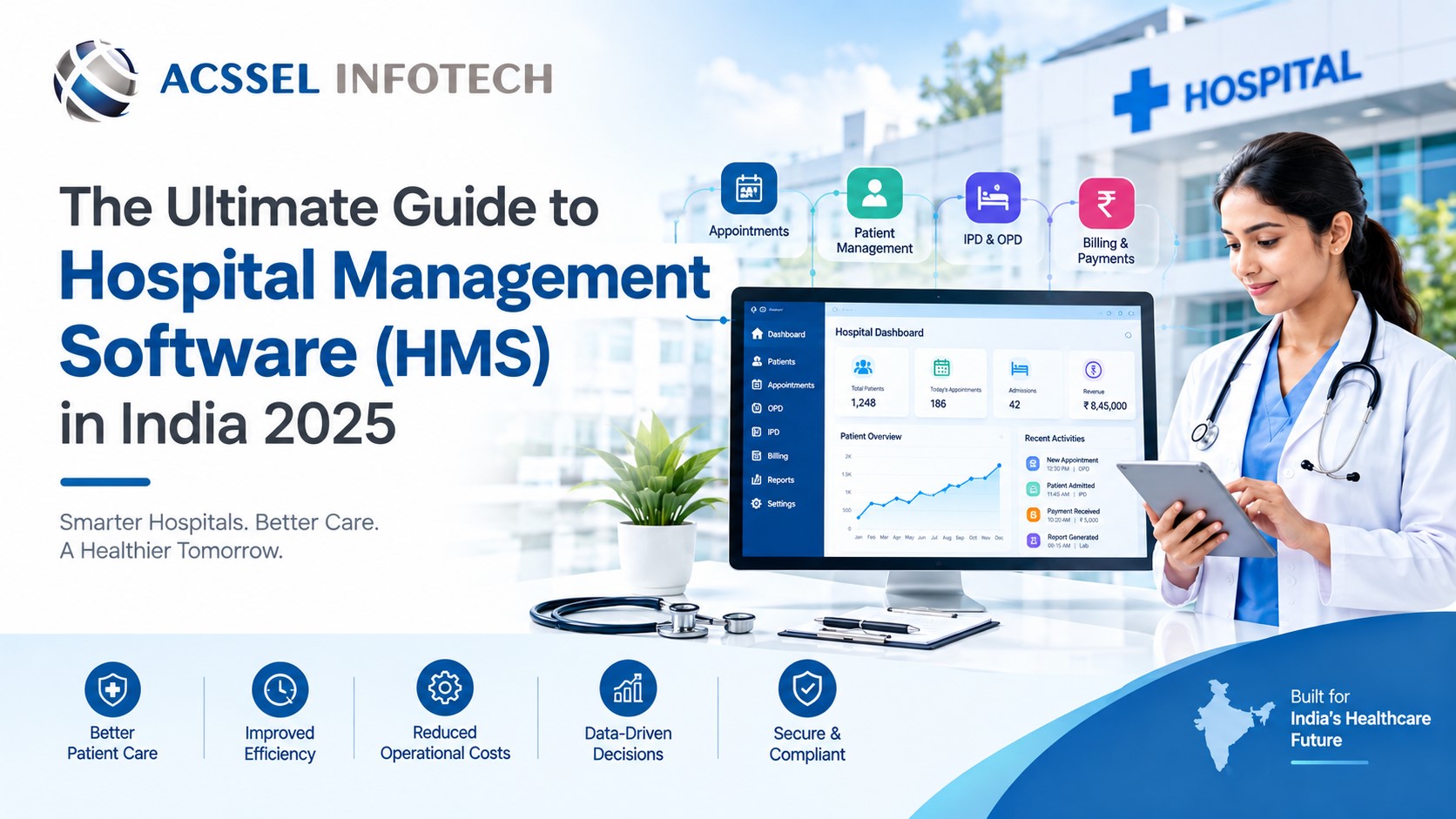
Hospital Management Software is an integrated digital platform that connects every department of a hospital — outpatient, inpatient, pharmacy, laboratory, billing, inventory, and administration — into a single, unified system.
Instead of managing separate software tools for appointments, billing, and records, HMS brings everything under one roof. Doctors access patient histories in seconds. Finance teams generate GST-compliant bills automatically. Administrators track bed occupancy in real time.
Simply put, HMS replaces chaos with control.
Did you know? India's hospital management software market is projected to grow from USD 12.4 billion in 2025 to USD 25.7 billion by 2031 — a clear sign that digital transformation in Indian healthcare is no longer optional.
India's healthcare sector is at an inflection point. The Ayushman Bharat Digital Mission (ABDM) has already issued over 79 crore ABHA IDs, and more than 1.59 lakh health facilities are now using ABDM-enabled software.
Yet gaps remain:
For hospitals that are still paper-based or partly digital, the window to upgrade is now — before compliance mandates and patient expectations make the transition even harder.
For hospitals already using basic software, 2025 is the year to upgrade to a comprehensive HMS that covers clinical, administrative, and financial operations together.
A robust HMS is not just one tool — it is a suite of interconnected modules. Here is what a full-featured Hospital Management Software should include:
Acssel's HMS covers all of the above modules and more — built specifically for Indian hospitals, clinics, nursing homes, and multi-specialty facilities.
Many hospital owners confuse Hospital ERP with a standard HMS. Here is a simple way to understand the distinction:
For most Indian hospitals with up to 200 beds, a feature-rich HMS delivers everything needed without the overhead of a full ERP. As your facility grows, the right HMS can scale into an ERP-grade platform.
One of the biggest decisions you will make is where your software lives — in the cloud or on your servers.
Cloud-based HMS is ideal for hospitals prioritising low upfront investment, remote access, and automatic compliance updates. It is also the fastest-growing segment in India — with tier-1 metro hospitals running at 71% cloud adoption.
Implementing a modern HMS delivers measurable returns across every area of hospital operations:
Not every HMS is the right fit. Before you sign any contract, evaluate vendors on these criteria:
Hospital Management Software is not one-size-fits-all. The right solution depends on your facility type:
Acssel offers tailored HMS solutions for each of these segments, ensuring you only pay for what you actually need.
India's healthcare IT market is projected to reach USD 112 billion by 2034, growing at a CAGR of nearly 20%. Government initiatives like ABDM, Ayushman Bharat, and eSanjeevani are actively pushing hospitals toward digital-first operations.
Hospitals that invest in a robust HMS today are not just buying software — they are building the digital foundation for long-term growth, compliance, and patient trust.
The question is no longer whether to adopt HMS. It is which HMS to choose.
Q1. What is Hospital Management Software (HMS)?
HMS is an integrated digital platform that manages all clinical, administrative, and financial operations of a hospital — from patient registration and OPD to billing, pharmacy, lab, and reports — in one connected system.
Q2. How much does Hospital Management Software cost in India?
Pricing varies based on facility size and modules. Small clinics may pay ₹3,000–₹8,000 per month on a subscription model, while mid-size hospitals typically invest ₹15,000–₹40,000 per month. Custom solutions are also available.
Q3. Is cloud-based HMS safe for patient data?
Yes. Reputable cloud HMS platforms use AES-256 encryption, regular backups, and role-based access controls. Many are also ABDM-compliant and follow India's health data standards.
Q4. What is the difference between HMS and Hospital ERP?
HMS focuses on clinical and administrative workflows. Hospital ERP extends this to cover HR, payroll, supply chain, and enterprise finance — suitable for larger or multi-branch hospital groups.
Q5. How long does it take to implement HMS?
Core modules like billing and registration typically go live within 4–6 months. Full clinical and analytics deployment can take 12–18 months depending on hospital size and complexity.
Q6. Does Acssel's HMS support ABDM compliance?
Yes. Acssel's HMS is designed to support ABDM standards, enabling your hospital to participate in India's national digital health ecosystem.
Q7. Can Acssel's HMS be customised for my hospital?
Absolutely. Acssel specialises in customised healthcare software tailored to your specific workflows — whether you run a single-specialty clinic, a nursing home, or a multi-specialty hospital.
Acssel Infotech has been helping Indian hospitals, clinics, and healthcare facilities digitise their operations with purpose-built, customisable Hospital Management Software (HMS) solutions for over 10 years. From OPD and IPD management to billing, pharmacy, laboratory, and analytics, every module is designed to support real Indian healthcare workflows.
📅 Schedule a Free Demo Today! See Acssel's HMS in action with a live, personalised walkthrough tailored to your facility type.
👉 Book Your Free Demo at Acssel.com | 📞 +91-8108102062 | ✉ info@acssel.com