 Clinic Management System Transforms
Did you know the global clinic management software market was valued at USD 2.5 billion in 2023 and is projected to reach USD 6.4 billion by 2031 (Verified Market Research, 2024)? That explosive growth tells one story: clinics running on paper registers and spreadsheets are falling behind.
If you own or manage a clinic, you know the daily chaos. Missed appointments drain revenue. Billing errors trigger disputes. Patient files go missing when you need them most. Your staff spends hours on tasks a computer should handle in seconds.
A clinic management system solves these problems in one platform. It automates scheduling, billing, patient records, and reporting so your team can focus on care, not paperwork.
At Acssel Infotech, we build and implement clinic management solutions for general practitioners, dental clinics, IVF centers, eye clinics, diagnostic centers, and physiotherapy practices. This guide draws on our hands-on implementation experience to show you exactly how the right system transforms a practice — and what to look for before you buy.
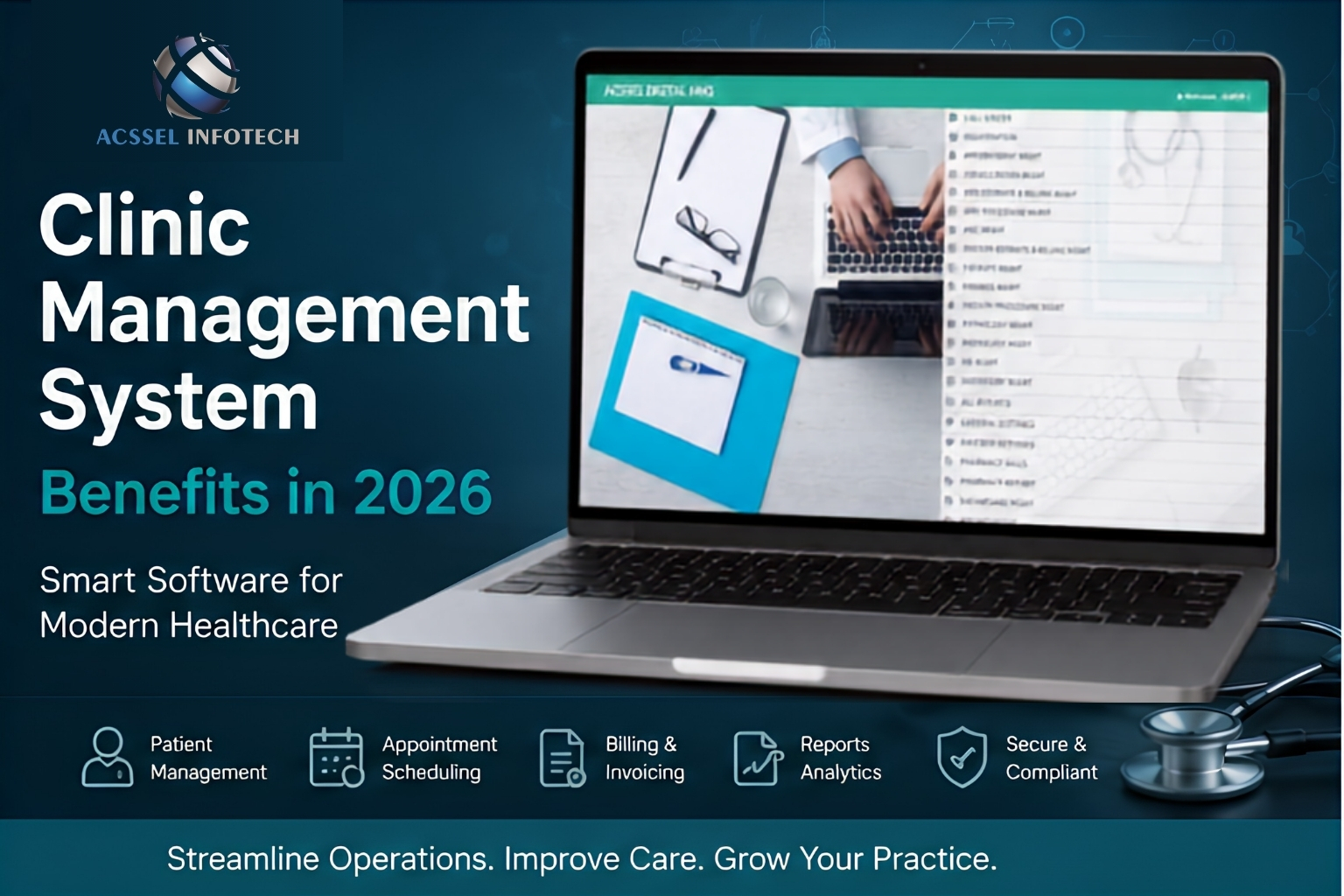
Before evaluating vendors, every clinic owner needs a clear picture of what this software actually does. A clinic management system sits at the center of your practice, connecting front-desk operations, clinical workflows, and finance. It often integrates with Electronic Health Records (EHR) to unify administrative and clinical data.
A clinic management system is software that runs a clinic's daily operations from one dashboard. It handles appointment scheduling, patient registration, medical records, billing, and reports. Staff enter data once, and the system shares it across every department. For example, a receptionist books a slot, and the doctor, pharmacy, and billing desk see it instantly.
Integrated systems dominate the market for a reason. The integrated systems segment held the largest share of the practice management market because they combine EHR, billing, patient engagement, and e-prescribing in one platform (Fortune Business Insights, 2025).
Solo general practitioners, multi-specialty clinics, dental and eye clinics, IVF centers, diagnostic labs, and physiotherapy practices all rely on the same core workflows — scheduling, records, and billing — customized to their specialty.
No-shows are one of the biggest silent revenue leaks in outpatient care. Every empty slot is a consultation fee lost and a patient whose treatment gets delayed. Automated scheduling with SMS and WhatsApp reminders attacks this problem directly.
Appointment scheduling software lets patients book, reschedule, or cancel online. The system then sends automatic reminders by SMS, email, or WhatsApp before each visit. It also maintains waitlists to fill cancelled slots. A clinic using automated reminders keeps its calendar full without staff making manual phone calls.
Industry analysis shows predictive scheduling algorithms can reduce no-show rates by 18–27% (Dataintelo, Clinic Management Software Market Report, 2026). For a clinic seeing 50 patients daily, recovering even 10% of missed slots adds thousands to monthly revenue.
Billing errors, missed charges, and slow insurance claims quietly erode margins. Revenue cycle management (RCM) — the process of tracking money from booking to final payment — is where software delivers its fastest return on investment.
Clinic billing software generates invoices automatically from consultations, procedures, and pharmacy items. It tracks pending payments, applies correct rates, and flags unbilled services. Clinics use it to close revenue leakages, speed up insurance claims, and produce GST-compliant invoices in seconds instead of minutes.
Billing is the single largest functionality segment in the medical practice management software market, earning the largest share of all modules (SkyQuest, 2025). AI-assisted revenue cycle tools now achieve claim denial rates as low as 3.2% versus an industry average of 8.9% (Dataintelo, 2026).
In our experience at Acssel Infotech, the most common leak we find during onboarding is unbilled consumables and procedures — items delivered but never invoiced. Automated charge capture typically surfaces these within the first month of go-live.
Patient management is more than storing files. Doctors need complete history — allergies, prescriptions, lab results, past visits — at the point of care. EHR (Electronic Health Record) integration makes that possible and reduces clinical errors.
EHR integration connects patient medical records directly to your clinic management system. Doctors view history, prescriptions, and lab reports during consultations without switching software. This prevents duplicate tests and medication errors. For example, an IVF clinic can track a patient's full treatment cycle across months in one timeline.
The shift from manual records to electronic health records has transformed record-keeping and is a primary driver of practice management adoption worldwide (Fortune Business Insights, 2025). Ambient AI documentation tools now cut physician charting time by 35–50% (Dataintelo, 2026).
Deployment choice affects cost, security, and how you scale. Cloud-based (SaaS) systems run on remote servers you access via browser; on-premise systems live on computers inside your clinic. Most small and mid-size clinics today choose cloud.
Cloud-based clinic software stores data on secure remote servers and works from any device with internet. It needs no server hardware and updates automatically. On-premise software runs on local machines and gives direct data control. Multi-location clinics prefer cloud because every branch shares one live database.
Cloud deployment captured over 46% of the medical practice management software market in 2024 and is the fastest-growing segment, driven by lower upfront costs and remote access (Verified Market Research, 2025).
| Feature | ☁️ Cloud-Based | 🖥️ On-Premise |
|---|---|---|
| 💰 Cost | Low monthly subscription | High upfront investment |
| 📱 Access | Access from anywhere on any device | Available only within clinic premises |
| 🛠️ Maintenance | Managed by the software vendor | Handled by your in-house IT team |
A dental clinic, a diagnostic center, and a physiotherapy practice do not run the same workflows. The biggest implementation failures we see come from buying generic software and forcing specialty workflows into it.
Choose a clinic management system by matching it to your specialty workflow first. Dental clinics need tooth charting. IVF centers need cycle tracking. Diagnostic labs need test result management and report delivery. Then verify data security, training support, and pricing. Always request a live demo with your own patient scenarios.
Small group practices are the fastest-growing buyer segment, projected to grow at over 10% CAGR through 2030, as specialty-fit and affordable cloud tools become widely available (Mordor Intelligence, 2025).
As the implementation team at Acssel Infotech puts it: "Software doesn't fix a clinic — workflows do. The system only wins when the front desk, doctors, and billing staff all use it the same way from day one."
Original Insight:
The clinics that see results fastest are not the ones with the biggest budgets. They are the ones that appoint one internal "system champion" — usually a practice manager — who owns adoption for the first 60 days. In our implementations, clinics with a champion reach full staff adoption roughly twice as fast as those without one. Budget for training time, not just license fees.
Q1. What is a clinic management system?
A clinic management system is software that runs a clinic's daily operations from one dashboard. It handles appointment scheduling, patient registration, medical records, billing, and reporting. Staff enter data once, and every department stays in sync.
Q2. How much does a clinic management system cost?
Pricing varies by clinic size and modules. Cloud-based systems typically use monthly subscriptions with low upfront cost. On-premise systems require a larger one-time investment. Most small and mid-size clinics find cloud subscriptions more cost-effective.
Q3. Can a clinic management system reduce patient no-shows?
Yes. Automated SMS, WhatsApp, and email reminders combined with online rescheduling and waitlist management significantly reduce no-shows. Industry analysis reports predictive scheduling can cut no-show rates by 18–27%.
Q4. Is cloud-based clinic software secure for patient data?
Reputable cloud clinic software uses encryption, role-based access controls, and automatic backups. Always verify the vendor's data security practices, hosting location, and compliance with applicable healthcare data regulations before purchase.
Q5. Which clinics benefit most from a clinic management system?
General practitioners, multi-specialty clinics, dental clinics, IVF centers, eye clinics, diagnostic centers, and physiotherapy practices all benefit. Any clinic handling appointments, patient records, and billing gains efficiency and revenue visibility from a management system.
A clinic management system is no longer a luxury reserved for large hospitals — it is the operational backbone of every efficient modern practice. It cuts no-shows through automated reminders, plugs billing leaks, secures patient records, and gives you real-time visibility into your clinic's performance. Whether you run a solo GP practice or a multi-specialty chain, the right system pays for itself through recovered revenue and saved staff hours. The clinics that adopt now will outpace those still buried in paperwork.
---
Ready to see what a modern clinic management system can do for your practice? Visit us at Acssel Infotech for a free, no-obligation demo tailored to your specialty
Acssel Infotech is a healthcare technology company specializing in clinic management systems for general practitioners, dental, IVF, eye, physiotherapy, and diagnostic practices. With hands-on implementation experience across multiple specialties, the Acssel Infotech team helps clinics digitize operations, reduce revenue leakage, and improve patient experience through practical, workflow-first software deployment.